Genetic context
Inherited predisposition
Variants related to androgen signalling may help contextualize how the hair cycle responds over time. Genetic context is read as predisposition, not destiny.
Atlas Trace — Example Report: Hair Resilience
This is an example report for one Atlas Trace use case (Hair Resilience). Other use cases include athletic recovery, biological age, and more.

Atlas Protocol · Application lens
One Atlas Protocol report, read through the lens of hair-related change.
Atlas Protocol · Report
Atlas Protocol turns one sample into structured insight across biomarkers, genetic context, and longitudinal signals. This page shows how that report can be read through one practical lens: hair-related change.
How to read this page
Atlas Protocol is the broader report system. What follows is one application lens — a structured way of reading the same report when the question is hair-related change. The underlying measurements can be read through other lenses; this one is intentionally focused.
Atlas does not diagnose hair loss. Each signal below is presented with its reference frame so the full picture stays legible, and so the report can support — not replace — a clinical conversation.
Start with the lens
We state what this reading is looking at — and what it is not claiming.
Move through the signals
Genetic context, biomarker context, and longitudinal trends appear as inputs, each with its reference frame.
End in considered next steps
Interpretation points toward questions to discuss and directions to consider — not definitive answers.
What this lens looks at
These are the inputs this lens draws on. Each one may surface relevant factors; none, on its own, explains what is observed.
Genetic context
Variants related to androgen signalling may help contextualize how the hair cycle responds over time. Genetic context is read as predisposition, not destiny.
Biomarker context
Iron stores, thyroid status, and vitamin D are common, often reversible factors that may surface in interpretation. They are one lens on biology, not a verdict.
Longitudinal tracking
Atlas Protocol is built to be re-read over time. Trajectory supports interpretation in a way a single snapshot cannot.
Biology before visible change
Biology often shifts before visible change is apparent. Reading the report earlier may help contextualize what is, and is not, already moving.
Clinician-readable interpretation
Findings are presented in a format a clinician can review. The report is decision-support, not diagnosis, and sits alongside clinical judgement.
Structured follow-through
Interpretation ends in considered next steps — questions to ask and paths to consider — rather than a fixed prescription.
Atlas Protocol is decision-support software, not a medical diagnosis. This lens does not claim that any single factor above explains an observed change; its value is in reading them together, alongside clinical judgement.
What the report shows
An Atlas Protocol report is not a single number. It is a layered view of your biology — read from broad context down to the specific question at hand. The lens on this page happens to be hair-related change, but the same underlying layers support other interpretation lenses too.
The layers below describe the report's anatomy. Which layer matters most depends on the question being asked.
Overall biological context
The broad view — where current biology sits in relation to typical reference frames, before any specific question is asked.
Priority systems & domains
A structured read across organ systems and biological domains, surfacing where signal is clearest and where attention may be worth directing.
Lens-specific context
For this page, that lens is hair-related change: the subset of biology most relevant to the growth cycle, pulled from the same underlying report.
Longitudinal comparison
Where a previous sample exists, the report can be re-read to compare trajectories. Atlas Protocol is designed to be read over time, not just once.
Clinician-readable output
A concise summary, in a format a clinician can review. Decision-support that sits alongside clinical judgement rather than replacing it.

Biological context
The hair growth cycle sits downstream of many systemic processes.
Why hair-related change is broader than hair
Hair change is rarely a story about hair alone. The growth cycle responds to many upstream biological processes, which is why reading a single, narrow hair marker is usually not enough. Atlas Protocol may help contextualize a change like this by reading across domains that can shape it over time.
Nutrient-related context
Iron stores, B-group vitamins, vitamin D status
Inflammation-related context
Acute-phase signals and systemic inflammation
Hormonal or thyroid-related context
Thyroid axis and androgen-related signalling
Vascular or metabolic context
Glucose-insulin balance and lipid patterns
Genetic predisposition
Inherited sensitivity that frames the baseline
Longitudinal biological change
How these domains move from one sample to the next
These are domains the report may help contextualize. They are not claimed as causes, and their presence in an interpretation does not amount to a diagnosis.
Example report modules that may matter here
Each module below is a slice of the report that may help contextualize hair-related change. The same modules support other interpretation lenses when the question is different.
M · 01
Reads iron stores (ferritin), vitamin D, and related micronutrient context — common, often reversible factors the report may help contextualize.
M · 02
Surfaces thyroid-axis context alongside broader endocrine signal. May help contextualize systemic shifts that express in the growth cycle.
M · 03
Reads acute-phase and systemic inflammation context that can accompany, mask, or alter how other markers should be read.
M · 04
Reads glucose-insulin balance and lipid patterns — upstream context that may help frame longer-horizon change.
M · 05
Reads inherited variants relevant to androgen-related signalling. Framed as predisposition, not destiny, and never read in isolation.
M · 06
Once a second sample exists, the same modules are re-read against the first. Trajectory is where the report tends to become most useful.
Module names are illustrative of how the report is structured for interpretation. They describe domains the report may help contextualize, not guaranteed clinical measurements. Atlas Protocol is decision-support, not a diagnosis.
What's included
The pieces below make up one Atlas Protocol report. Together they form the basis for any interpretation lens — this page happens to read them for hair-related change.
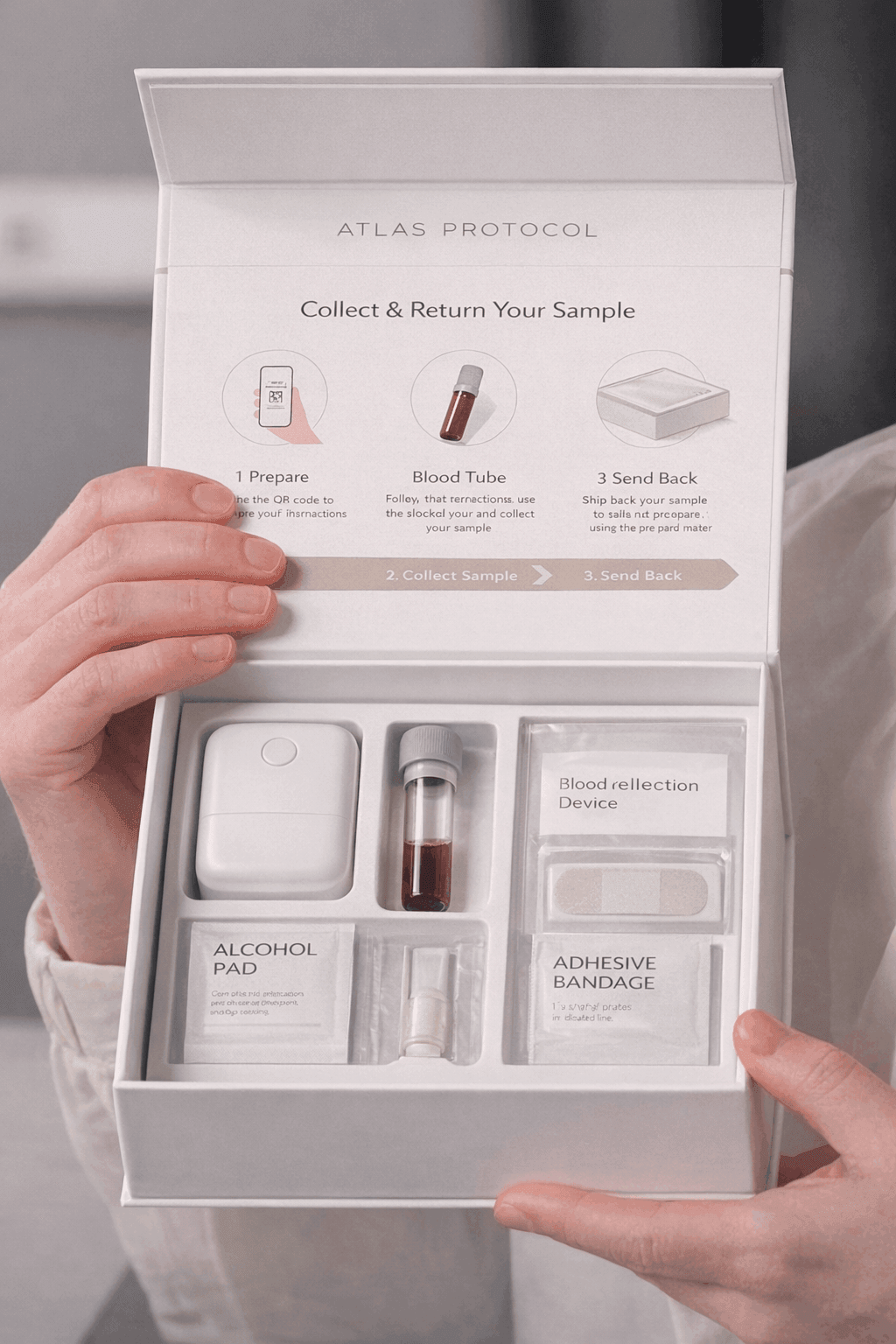
At-home collection kit
A single calibrated sample taken in your own time, at home.
Biomarker panel
A structured read across biomarkers that form the biological backbone of the report.
Genetic context, where applicable
Inherited variants are read as predisposition, framing how other signals should be interpreted.
Clinician-readable summary
A concise output a clinician can review — decision-support, not a diagnosis.
Protocol guidance
Considered next steps drawn from the report, written as directions to discuss.
Progress tracking
The report is designed to be re-read over time so change can be followed, not guessed.
How it works
Three steps, designed to make the process feel calm and deliberate. No clinic visit required.
Step 01
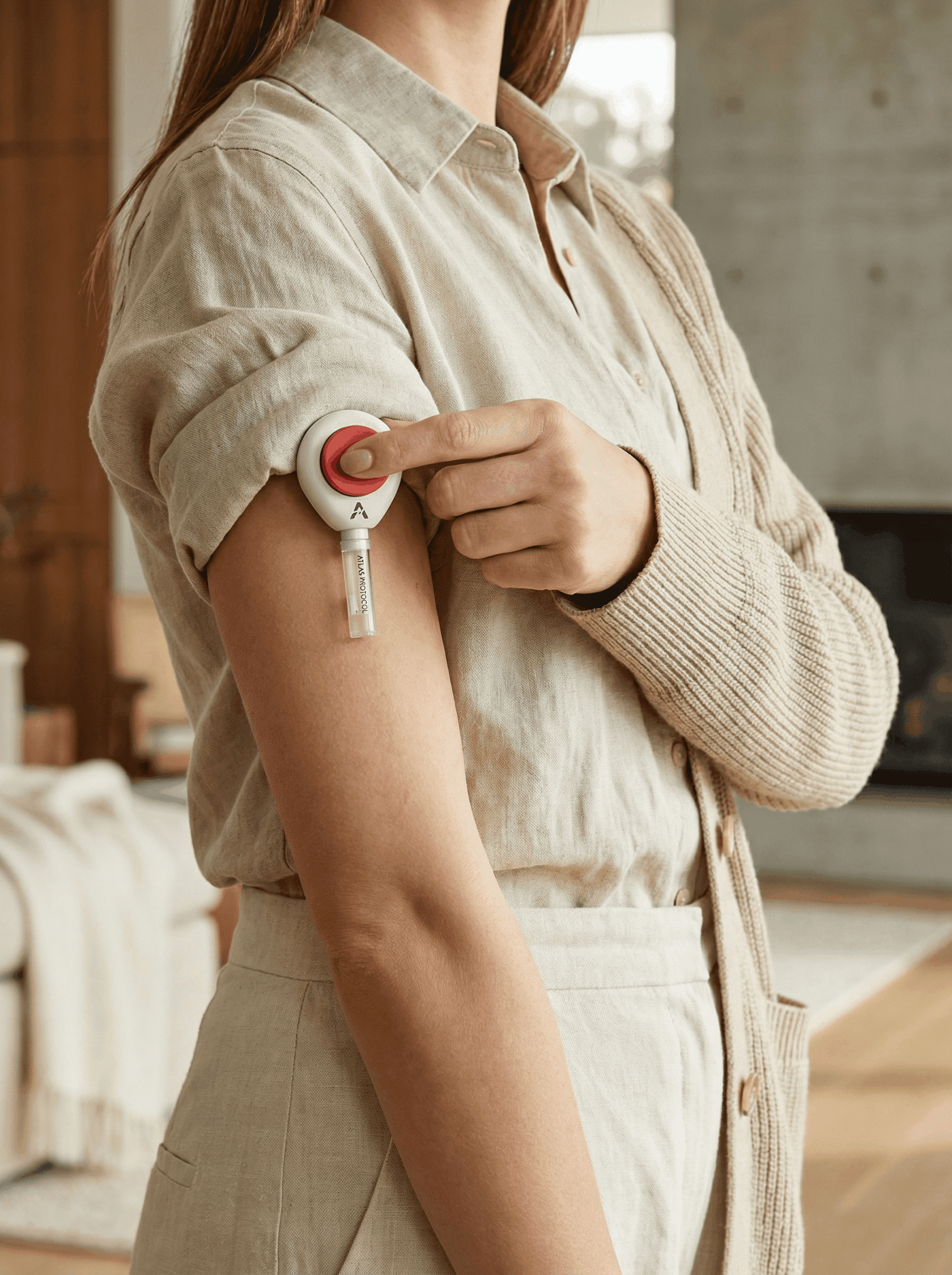
Collect at home
Take your sample in your own time using the Atlas Protocol kit, then send it back. No clinic visit required.

Step 02
Receive your report
Your sample becomes a structured, clinician-readable Atlas Protocol report — read across biomarkers, genetic context, and systems.
Step 03
Track change over time
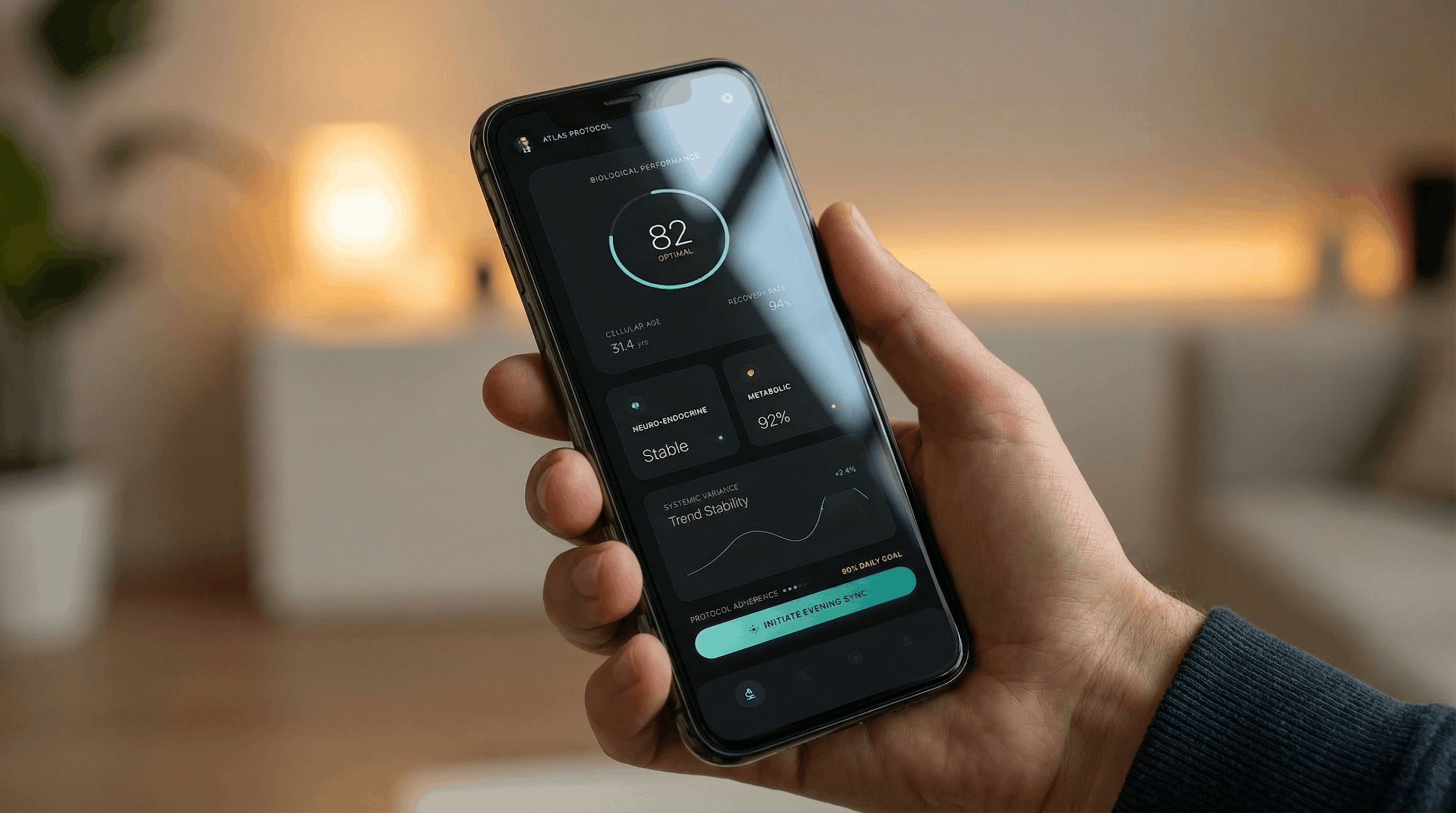
The report is designed to be re-read. Later samples sit next to earlier ones so trajectory stays visible and interpretation gains longitudinal follow-through.
Example dashboard · illustrative
What follows is an illustrative rendering of how one Atlas Protocol report may read through the hair-related change lens — KPIs, interpretation ring, biomarker deep-dive, longitudinal timeline, and a structured summary for a clinician. Values below are placeholders for layout, not personal results.
Hair Resilience
40/ 100
Risk Score
8.5/ 10
Ferritin
22ng/ml
Vitamin D3
18ng/ml
TSH
2.1mU/l
Summary: High Sensitivity to DHT
Risk
8.5
This score reflects DHT receptor sensitivity and suggests a higher chance of progressive thinning without protection.
The main lever is DHT protection + adherence. See plan
Based on AR, EDA2R variants.
Biology and hair density do not evolve in sync — track both curves in parallel.
Biology index: 95.8
Hair density: 82
Density Δ vs previous: 3
Lead/lag: biology changes lead density by ~8–12 weeks.
Current biology trend
+84.9 pts (12m)
Relative: ↑ +778.6%
Current density trend
+38 pts (12m)
Relative: ↑ +86.4%
Estimated lag window
8–12 weeks
Current Hair Resilience
67.3 / 100
Next recommended action
Move to protocol planMorning and evening routines that directly improve your markers.
Iron Bisglycinate
Ferritin unter Zielbereich reduziert die Energieversorgung in der Haarwurzel.
Supported by Atlas Protocol · See the report
ReorderVitamin D3 + K2
D3 hilft, Follikel aus Ruhe in aktive Wachstumsphasen zu bringen.
Supported by Atlas Protocol · See the report
ReorderTopical DHT Protocol
Bei genetisch hoher DHT-Sensitivität sinkt Dichte ohne Schutz progressiv.
Supported by Atlas Protocol · See the report
ShopStress and sleep check
Metabolic stress can further destabilize the cycle.
Supported by Atlas Protocol · See the report
View guidanceA concise one-pager for your appointment. Not a diagnosis.
Hair loss / reduced hair density. Goal: evaluate reversible factors and discuss evidence-based options.
| Marker | Value | Unit | Reference range | Flag |
|---|---|---|---|---|
| Ferritin (Iron Storage) | 22 | ng/ml | 30 - 400 | Low |
| Vitamin D3 (25-OH) | 18 | ng/ml | 30 - 100 | High |
| TSH (Thyroid) | 2.1 | mU/l | 0.27 - 4.2 | OK |
| Vitamin B12 (Holo-TC) | 45 | pmol/l | > 35 | OK |
Reference ranges vary by lab; interpret clinically.
Decision-support software. Not a medical diagnosis. Reference ranges vary by lab; interpret clinically.
Frequently asked
A single Atlas Protocol report can be read through multiple interpretation lenses. These answers clarify how one biological read-out supports different questions over time.
No. Atlas Protocol is decision-support, not diagnosis. The report structures a biological read-out so it may help contextualize patterns a clinician or specialist can interpret. It does not replace medical assessment, treatment, or a physician's judgement.
Atlas Protocol supports interpretation of biology. It is not a medical device and does not provide a diagnosis or a prescription. Any clinical decision should be made together with a qualified clinician.
Next step
This page is one application lens on a single Atlas Protocol report. Order the full report to read your own biology — through this lens, and the others.